Welcome back to OPENING LINES, the interview series that puts playwrights centre stage by diving into the world of new writing and original work. Each interview explores the creative process, the challenges and triumphs of developing new ideas and work for the stage, why new voices and stories are essential to the future of theatre and what the industry is doing to nurture and support new writing.
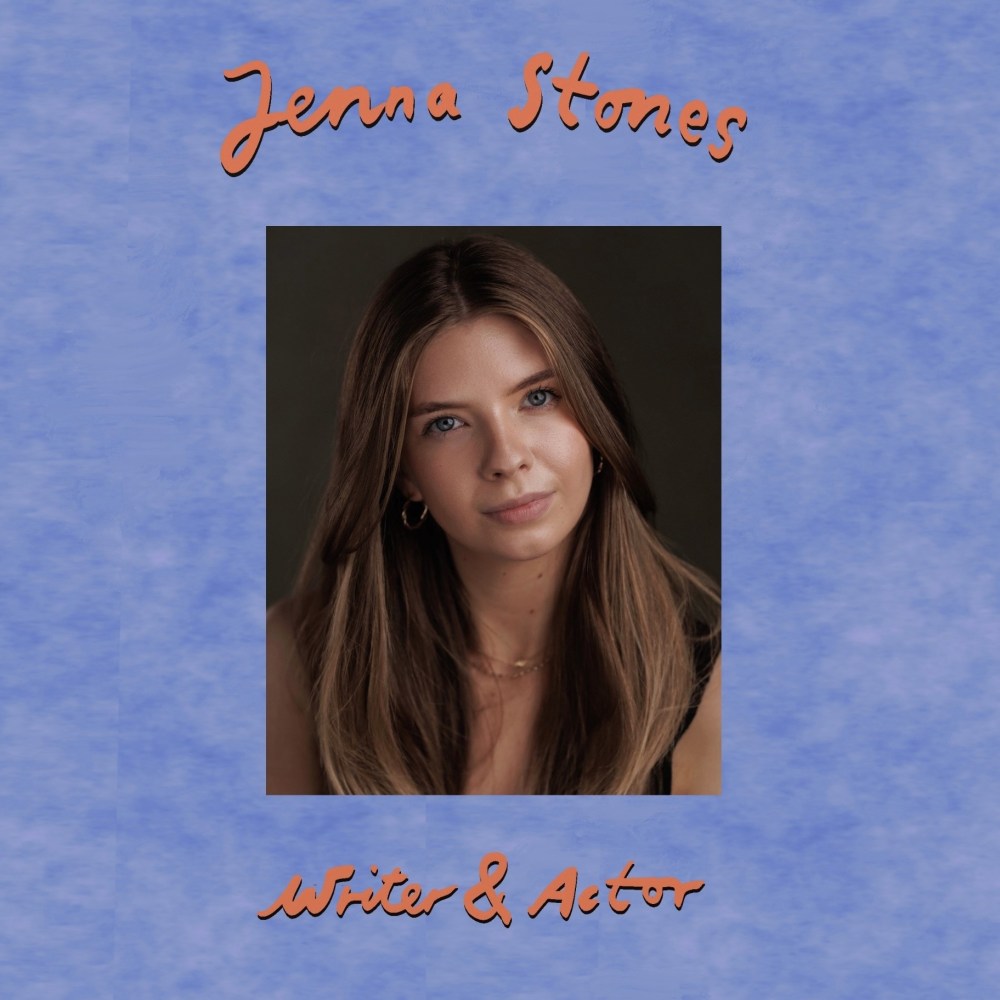
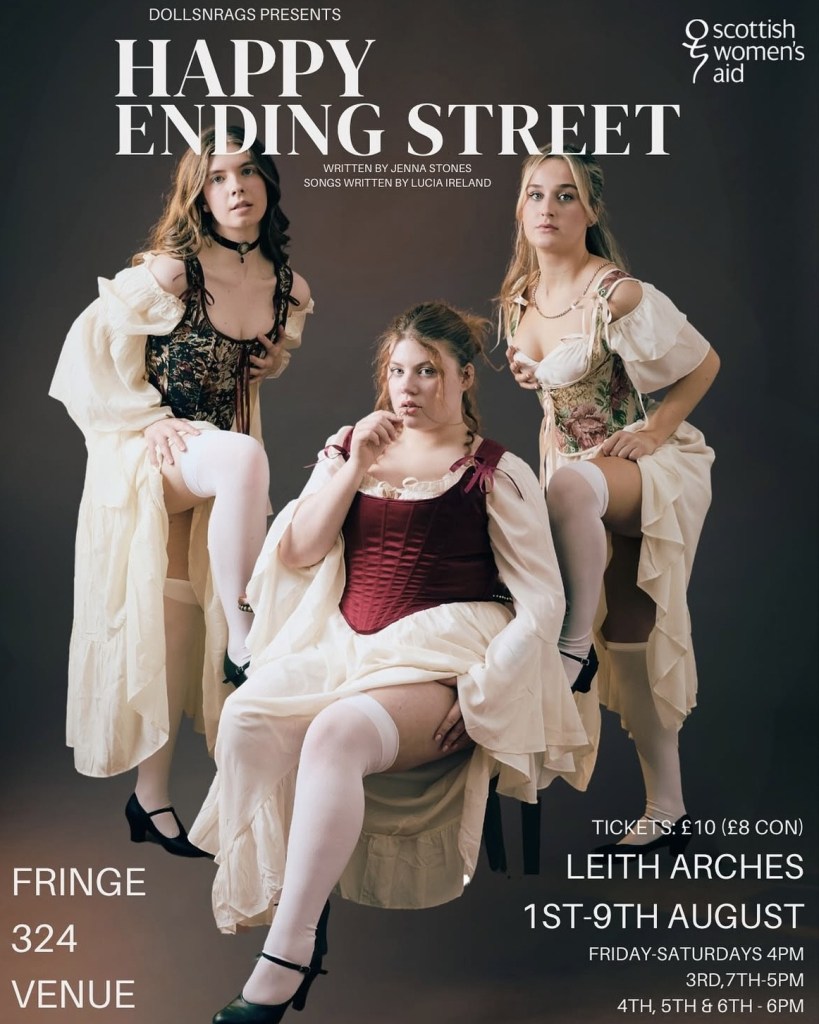
Edinburgh Fringe starts in just a few days people! I chatted to the awesome Jenna Stones, writer of HAPPY ENDING STREET which is on from 1st – 9th August at Leith Arches. Tickets available here!
HAPPY ENDING STREET is produced by DollsnRags Productions – a female-led company founded by Jenna Stones and Lucia Ireland. They are driven by a shared passion to spotlight the female experience both contemporary and historical. In HAPPY ENDING STREET, it’s time the bottom of the food chain fought back… with our lasses. Bonnie, Pearl and Frances, three sex workers trapped on the once-thriving Happy Ending Street, dream of escape. With stolen cash in hand and the odds stacked high, breaking free won’t be easy. But their sisterhood is unshakable.
Bold, razor-sharp and unapologetically feminist, this dark comedy tackles patriarchy, power and survival in a world that refuses to see them. Written by real women about real women, a rallying cry for those who won’t be silenced.
What inspired you to write HAPPY ENDING STREET?
HAPPY ENDING STREET was created from a third-year workshop during my Acting and Performance degree at Queen Margaret University. We were asked to create bold, archetypal characters from the Restoration period. I developed a sex worker character who said, “You’ll find me on the edge of Happy Ending Street.” My lecturer, Robin Wilson, immediately said, “That’s a great title for a play” and it stuck.
At the time, I was feeling frustrated by the lack of emotionally complex modern roles for women. I’ve always been drawn to classical characters for their richness, but I wanted to create something contemporary that offered the same depth.
The idea evolved during a moment of real-world upheaval such as the rise of incel culture, the overturning of Roe v. Wade, and the oppression of Afghan women. I felt angry and helpless, but also grounded by the idea of female solidarity. That feeling of sisterhood became the play’s foundation.
Around then, Lucia Ireland approached me about putting on a show at the Fringe. It was perfect timing. I was developing three contrasting female characters, and our different casting types helped shape the roles. The third character brought balance and variety to the group, making the story fuller and more dynamic.
What does bringing a show to Edinburgh Fringe mean to you? Is this your first time or have you been before?
This is my first time performing at the Edinburgh Fringe and my first time ever sharing my writing with an audience, so it feels both exhilarating and terrifying. There’s something incredibly vulnerable about putting your work out there, but the Fringe feels like the perfect place to do it. It’s a space that thrives on bold, new voices and celebrates fresh perspectives.
What makes this even more special is that it marks my transition from education into the wider creative world. It’s a chance to explore the kind of stories I want to tell, the characters I want to embody, and the work I truly believe in. Fringe-goers are here because they want to discover something new, and I hope our piece resonates with them especially when they see how much heart and effort both Lucia and I have poured into it.
I have so much admiration for anyone brave enough to share their writing, and to now be doing that myself, through DollsnRags and our original work, feels incredibly fulfilling. I always dreamed of performing at the Fringe one day, but to do it like this is more than I could have hoped for.
Were there any moments during the writing process that surprised you?
Definitely. What surprised me most was how much I was holding back from saying what I really wanted to say. When my lecturer Bruce Strachan read my first draft, he gave me kind but honest feedback: “It’s a lovely story.” He encouraged me to dig deeper, to get angry, and not be afraid to say the uncomfortable or even shocking things. That advice hit hard and made me realise how much I self-censor to avoid upsetting others or coming across over emotional.
I’m a people pleaser by nature, and the thought of alienating or offending an audience makes me uncomfortable. But I’ve come to understand that if I don’t write about the things I care deeply about—if I don’t allow myself to be bold—then the work risks losing its authenticity. It won’t connect in the way I want it to.
I still have to remind myself: Who does it serve if I hold back? If someone is offended, maybe my work just isn’t for them and that’s okay. Writing this play has been an exercise in courage, in learning to trust my voice, and in letting passion lead the way, even when it feels risky.
As the writer and creator, how did it feel to bring your own words and vision to life on stage?
Honestly, it was the strangest and most fulfilling feeling. Watching Breagha and Lucia bring the characters to life and sharing their thoughts, interpretations, and connections to the text felt almost like an out-of-body experience. I had to let go of everything I’d originally imagined and give them the freedom to take the characters somewhere new.
The most satisfying moment came when they just got it and instinctively understood their characters from what I’d written. That’s when I knew I’d done my job as a writer. It felt like a childhood dream to see people excited by my work and find meaning in it. That kind of validation was incredibly moving.
The whole process gave me a huge creative boost. There’s something amazing about watching performers interpret your writing it adds new layers, new colours, and unexpected nuances to the story. It’s made me even more passionate about creating work and collaborating with actors who can breathe life into it in ways I never imagined.
Did you learn or discover anything about the show during rehearsals that you didn’t expect to?
One of the biggest surprises was realising the potential for the show to grow both in scale and in depth. As we began rehearsals, it became clear that there’s so much more to explore in this world and with these characters. What felt subtle or understated in the script particularly the sadness and sense of helplessness really came to life in performance.
Lucia, Breagha, and I began to feel a profound emotional connection to the characters and their desire to escape. Our movement director, Stephanie Arsoska, led us through physical scores where we had to travel to a destination together, which helped us explore the tension between independence and interdependence. It deepened our understanding of the characters’ desperation and their unspoken reliance on one another.
We discovered a deep trauma bond between the women, something that can’t always be fully expressed in the text alone. The softness of their physical interactions, the way they comfort each other with care and caution, revealed a fragility in their relationships. We began asking questions like: how long have they known each other? Who arrived first? Those subtle, delicate dynamics added an unexpected emotional richness to the story.
How do you want audiences to think and feel about your show?
I want audiences to leave feeling entertained, but also curious wanting to know what happens next and feeling emotionally invested in the characters. Their story isn’t over, and if people leave with questions or a desire to see more, that’s the best outcome. I also hope they connect with the characters on a personal level. Each of them carries very human traits avoidance, selfishness, vulnerability and I think many people will see parts of themselves reflected back.
Most importantly, I hope the show sparks a sense of solidarity. It’s about the strength we find in each other, especially as women, and the importance of amplifying our voices. Everyone will interpret the piece differently, and that’s the beauty of theatre.
If performers or industry professionals feel inspired to collaborate with us after seeing the show, that’s incredibly exciting. And for female-identifying individuals, I hope they see this as a safe, creative space to tell bold, necessary stories.
If you could ask your audience one question after the show, what would it be?
What do you think happens next?
Do you see yourself continuing to explore similar themes and topics in your future work?
As long as the patriarchy exists and women’s rights continue to be under threat, I’ll keep exploring these themes whether they appear boldly or more subtly in the writing. These issues are generational, and they continue to affect us in ways both personal and political.
I’ve always been drawn to period pieces. They offer a powerful way to connect with the women who came before us, honouring their struggles while highlighting how much or how little has changed. There’s something beautifully escapist about diving into another era through costume, set, or sound, but it’s also a mirror. Period drama can reveal truths about today just as much as the past.
Exploring women’s stories across time, class, and experience feels like a creative commitment. It’s not just about looking back, but about making sure these voices are heard, remembered, and given space to grow in the present and future.
Do the works of other playwrights, writers or theatre-makers influence your own writing? Are there specific writers or plays that have shaped your approach to storytelling?
Absolutely. Yerma by Federico García Lorca and A Doll’s House by Henrik Ibsen have been particularly influential they both explore the emotional complexities of womanhood in an oppressive environment and their need to flee. I also deeply admire the work of Stellar Quines and F-Bomb Theatre for the way they champion female voices and bring bold, unapologetic stories to the stage.
In terms of contemporary writing, Liam Lambie’s When We Were Young really stuck with me. His ability to create raw, flawed Scottish characters and deeply funny dark comedy in his writing you can’t help but root for the characters which has definitely shaped how I approach character development and comedic timing.
Outside of theatre, film plays a big role in my inspiration. Little Women (directed by Greta Gerwig) was instrumental in capturing the intimacy and nuance of sisterhood, while Promising Young Woman(directed by Emerald Fennell) really tapped into the kind of feminine rage I often explore in my work. Both helped shape the tone and emotional core of my writing.
Do you feel that the theatre world is doing enough to support and nurture new writing? If not, what changes would you like to see?
There’s definitely support out there, but it’s not always easy to find especially in Scotland. Compared to other parts of the UK, there seem to be more opportunities for emerging writers outside of Scotland. That said, companies like Framework are doing great work in nurturing new voices, and initiatives like A Play, A Pie and A Pint continue to champion new writing.
However, we could really benefit from more accessible resources especially training on how to set up your own creative company, how to apply for funding outside of Creative Scotland, and clearer pathways into the industry. It often comes down to who you know, which can make it harder for new voices to break through.
The Fringe has been a brilliant space for discovering and sharing new work. I’ve felt so supported by others on this journey, but I’d love to see more established writers actively sharing, recommending, and uplifting emerging voices. There’s such a vibrant pool of talent here it deserves to be seen.
 the theatre gal